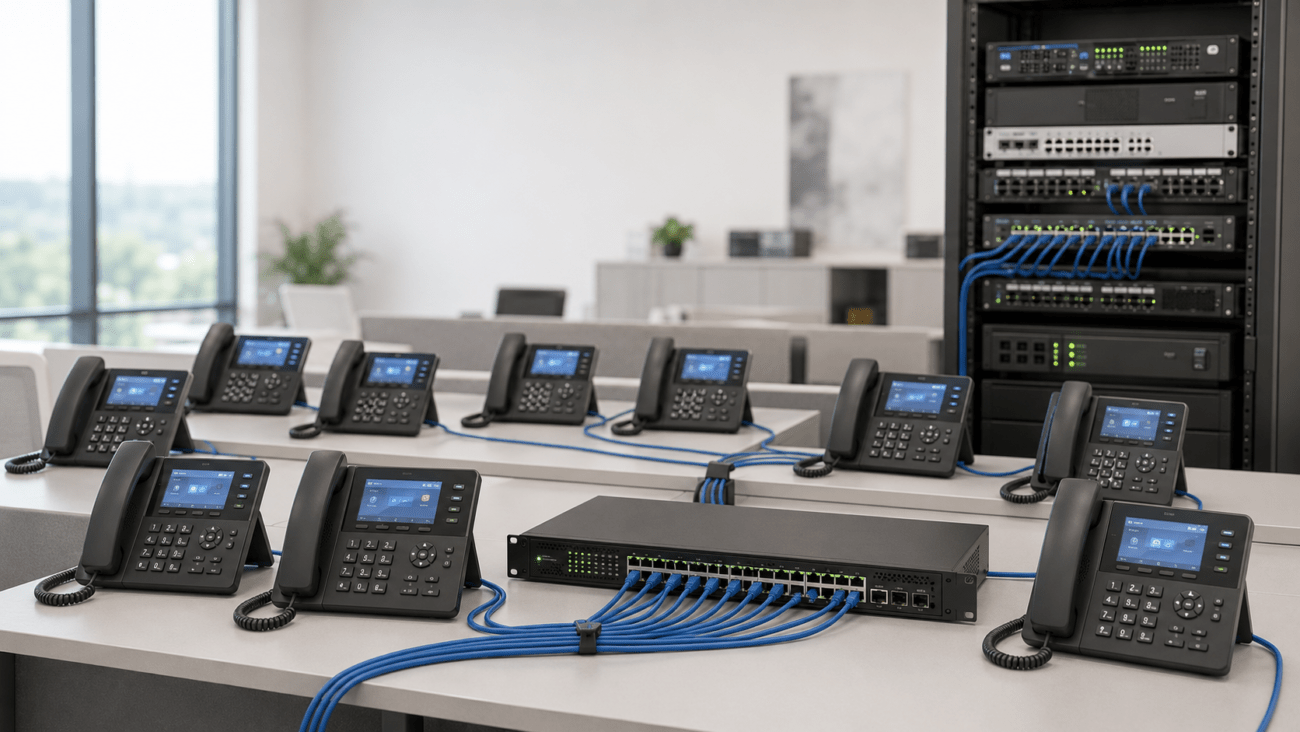
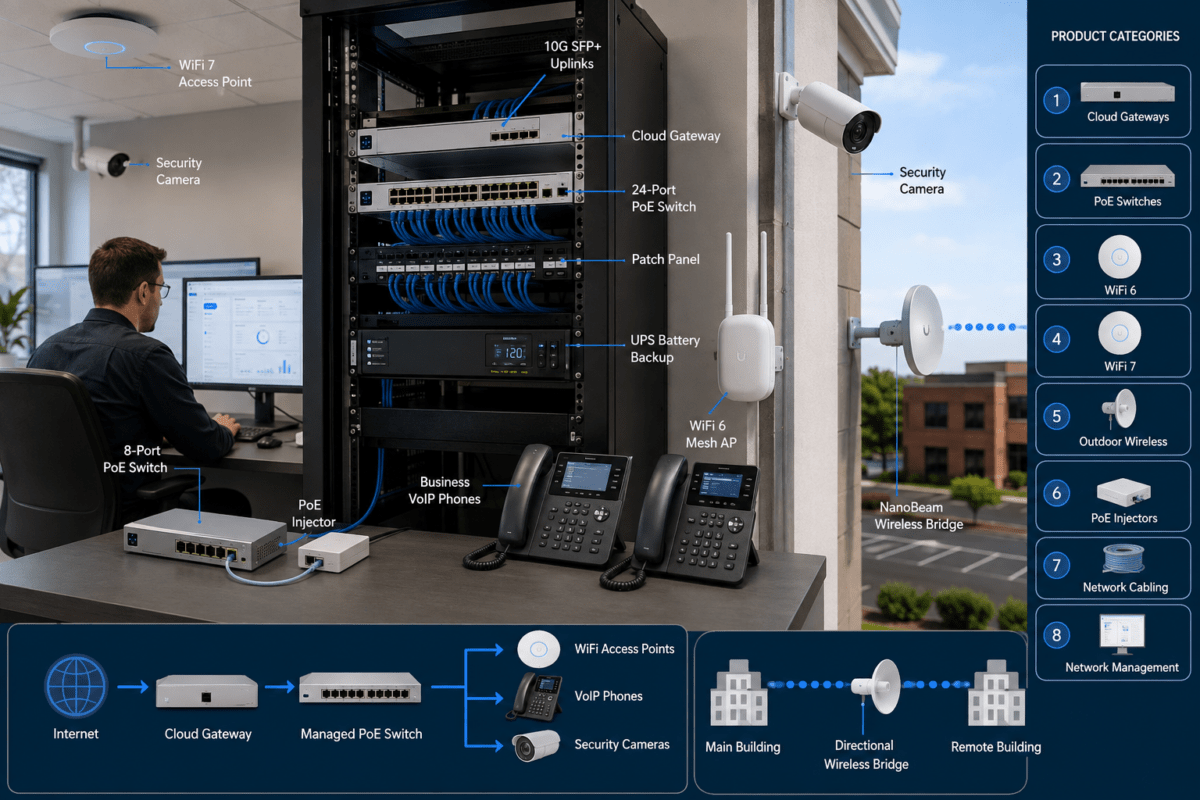
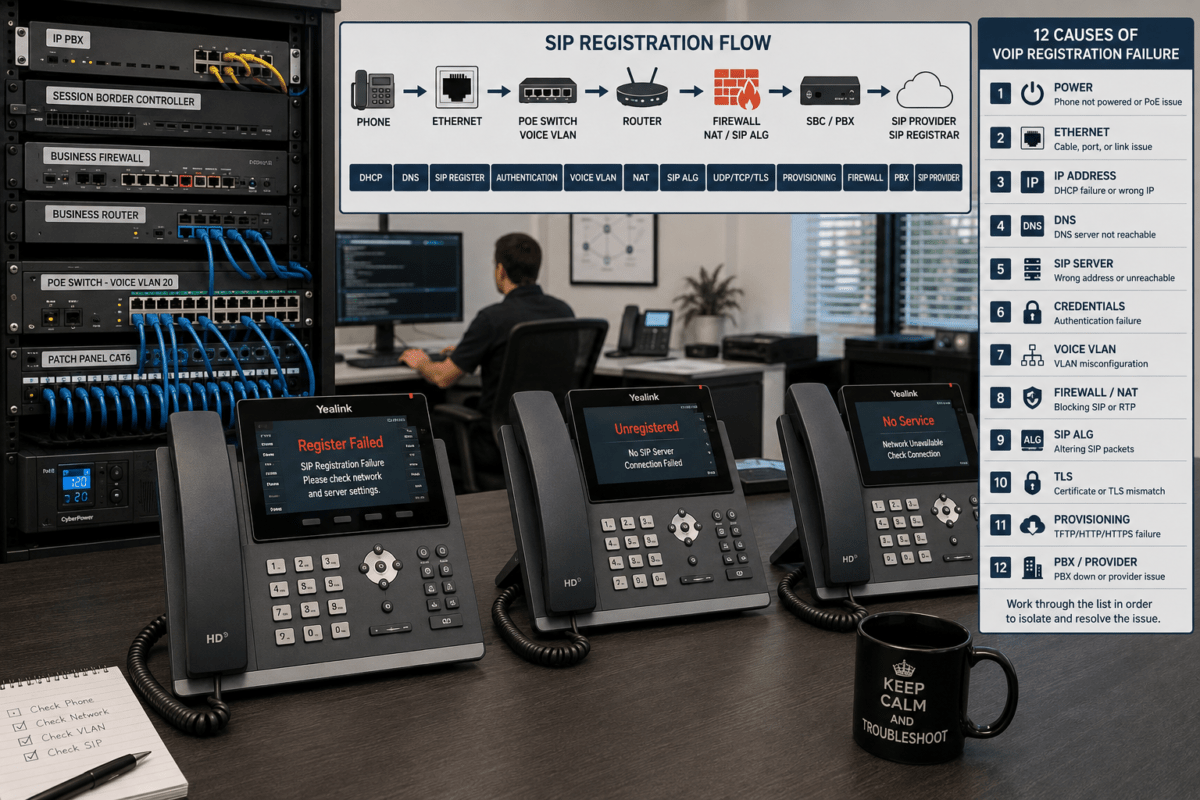
Power over Ethernet (PoE) has become an essential part of modern business networking. From IP phones and wireless access points to security cameras and intercoms, PoE allows compatible devices to receive both network data and electrical power through a single Ethernet cable.
However, not all PoE connections provide the same amount of power. The three common standards—PoE, PoE+, and PoE++—support different power levels, and choosing the wrong one can lead to equipment that fails to start, reboots unexpectedly, or cannot operate all its features.
This guide explains PoE vs. PoE+ vs. PoE++, how each standard works, and how to select the right network switch for your business.
What Is Power over Ethernet (PoE)?
Power over Ethernet is a technology that allows compatible network equipment to receive electrical power through the same Ethernet cable used for data communication.
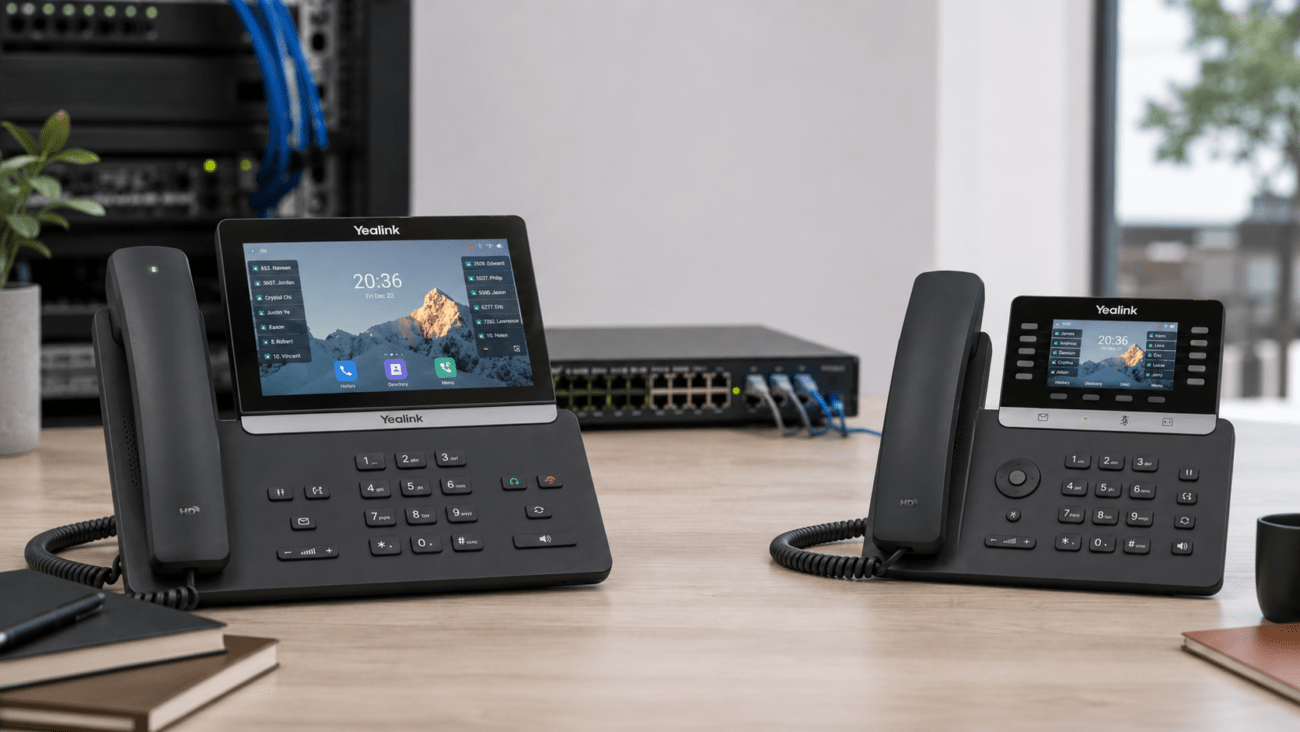
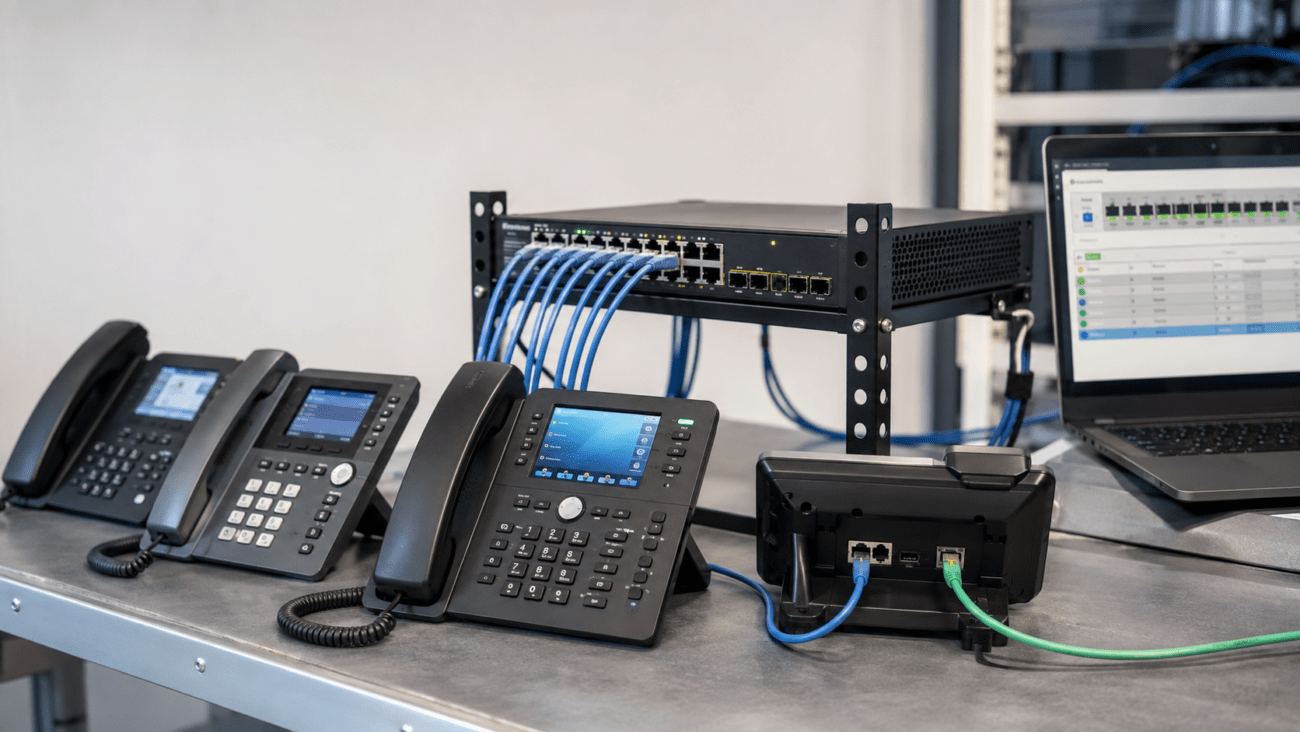
In a typical installation, a PoE-enabled network switch supplies power to a connected device. The switch is called the Power Sourcing Equipment (PSE), while the receiving device is called the Powered Device (PD).
Common PoE-powered equipment includes:
Business IP phones
Wireless access points
IP security cameras
Video door stations and intercoms
Network paging equipment
Building access-control devices
Other compatible network appliances
Because power and data share one cable, businesses can install compatible equipment without needing a separate electrical outlet at every device location.
PoE vs. PoE+ vs. PoE++: Quick Comparison
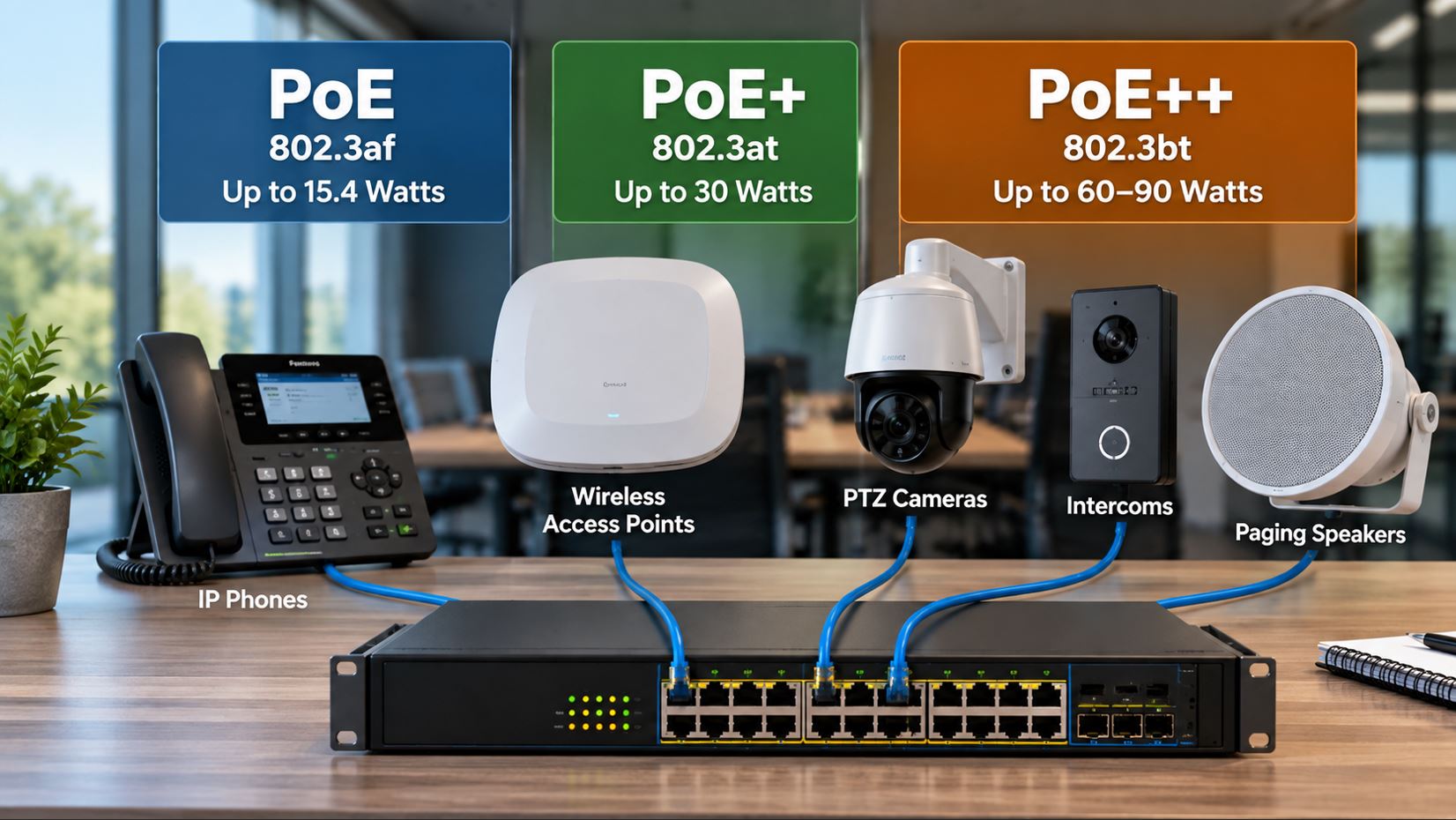
The most important difference between the standards is how much power they can deliver.
Feature
PoE
PoE+
PoE++
IEEE standard
802.3af
802.3at
802.3bt
Type
Type 1
Type 2
Type 3 or Type 4
Maximum power supplied at port
15.4 W
30 W
60 W / 90 W
Maximum power available at device
12.95 W
25.5 W
51 W / 71.3 W
Power pairs
2
2
Up to 4
Typical applications
IP phones, basic cameras
Wireless APs, advanced cameras
High-power APs, PTZ cameras, specialized devices
Important: The power supplied by the switch is not identical to the power available at the device. Ethernet cable resistance causes some power loss, which is why the device-side power ratings are lower.
Standard PoE, also called Type 1 PoE, supplies up to 15.4 watts at the switch port, with approximately 12.95 watts available to the connected device under the standard’s cabling assumptions.
It remains suitable for many lower-power networking devices.
Common PoE Applications
Basic SIP desk phones
Simple fixed IP cameras
Low-power intercoms
Other devices rated for IEEE 802.3af
For example, the Yealink SIP-T31P IP Phone supports PoE and can be deployed without a separate desktop power adapter when connected to a compatible PoE source.
For a small office requiring only a few PoE devices, the TP-Link TL-SG1008P Gigabit Switch provides four IEEE 802.3af PoE ports and a total PoE power budget of 55 watts.
Standard PoE can be an economical option when every connected device has relatively modest power requirements.
2. PoE+ (IEEE 802.3at)
PoE+ increases the maximum power supplied at the switch port to 30 watts, with up to 25.5 watts available at the powered device.
That additional capacity makes PoE+ suitable for many devices that require more power than basic IP phones or fixed cameras.
Common PoE+ Applications
Business wireless access points
Higher-performance IP cameras
Some video intercoms
IP phones with additional accessories, where required by the manufacturer
Other IEEE 802.3at-compatible equipment
Not every wireless access point requires PoE+. Some operate on standard PoE, while others require PoE++ or proprietary power arrangements. Always check the specific model.
Another option is the TP-Link TL-SG3218XP-M2 Managed Switch, which includes eight 2.5 Gigabit PoE+ ports, additional non-PoE ports, and a 240-watt PoE budget.
Multi-gigabit PoE+ ports can be particularly useful when the connected access point supports network speeds above 1 Gbps.
3. PoE++ (IEEE 802.3bt)
PoE++ is the higher-power generation of standardized Power over Ethernet. IEEE 802.3bt defines Type 3 and Type 4 power levels.
Type 3 can supply up to 60 watts at the port, while Type 4 can supply up to 90 watts. Actual device-side power availability is lower because of cable losses.
Unlike the earlier two-pair standards, higher-power 802.3bt operation uses all four twisted pairs in the Ethernet cable.
Common PoE++ Applications
High-performance wireless access points
Power-hungry PTZ security cameras
Some video intercom and access-control systems
Specialized network appliances
Equipment with substantial accessory power requirements
For demanding network installations, the EnGenius ECS5512FP 8-Port 10Gb PoE++ Switch supports IEEE 802.3af/at/bt on its copper ports and offers a 420-watt total PoE budget.
Before purchasing a PoE++ switch, verify whether the specific ports provide Type 3, Type 4, or both. A product labeled PoE++ does not automatically guarantee 90 watts on every port.
4. Understanding PoE Switch Power Budgets
One of the most common purchasing mistakes is confusing the maximum power available on an individual port with the total power available across the switch.
For example, a 24-port PoE+ switch may support up to 30 watts on each PoE+ port, but that does not mean it can deliver 30 watts simultaneously to all 24 ports.
The switch’s total PoE budget determines how much power can be distributed across all connected devices.
Example: Small Office PoE Requirements
Device
Quantity
Estimated Power per Device
Total
IP Phones
8
7 W
56 W
Wireless Access Points
3
20 W
60 W
IP Security Cameras
4
12 W
48 W
Total
15
164 W
In this example, the estimated combined demand is 164 watts. Adding approximately 25% planning headroom gives a target of about 205 watts.
A switch with a 240-watt PoE budget could be suitable, provided it has enough powered ports and each port supports the required device standard.
These wattages are illustrative. For a production installation, use each device manufacturer’s maximum PoE requirements and account for accessories, startup behavior, cable losses, and the switch’s allocation method.
5. Are PoE, PoE+, and PoE++ Backward Compatible?
IEEE-standard PoE systems are designed to support interoperability between generations, but available power still matters.
A PoE+ or PoE++ switch can generally power lower-power IEEE-compliant devices, provided the switch supports the required classification and power mode.
However, connecting a device that requires PoE++ to a standard PoE port does not magically increase the available power.
Depending on the device design, it may fail to start, operate with reduced functionality, or report insufficient power.
Always distinguish standards-based IEEE PoE from passive or proprietary power systems. A passive PoE injector may place voltage on the cable without the same negotiation and protection mechanisms used by compliant IEEE equipment.
6. Choosing the Right PoE Switch for IP Phones and Wireless Networks
Choosing a switch involves more than counting Ethernet ports.
For Small Offices
Businesses with a handful of IP phones and basic network devices may only need an 802.3af switch, assuming the devices’ specifications confirm compatibility.
The TP-Link TL-SG1008P is an example of a compact switch suited to smaller installations.
For Growing Businesses
Offices deploying multiple wireless access points, cameras, and phones should evaluate PoE+ switches with adequate power budgets and management features.
The EnGenius EWS7928FP-FIT provides 24 PoE+ ports and a substantial shared power budget.
For High-Performance Networks
Networks using high-power wireless access points, specialized cameras, or high-bandwidth endpoints may benefit from multi-gigabit or 10-gigabit switches with PoE++ capability.
The EnGenius ECS5512FP combines multi-gigabit/10-gigabit connectivity with higher-power PoE support.
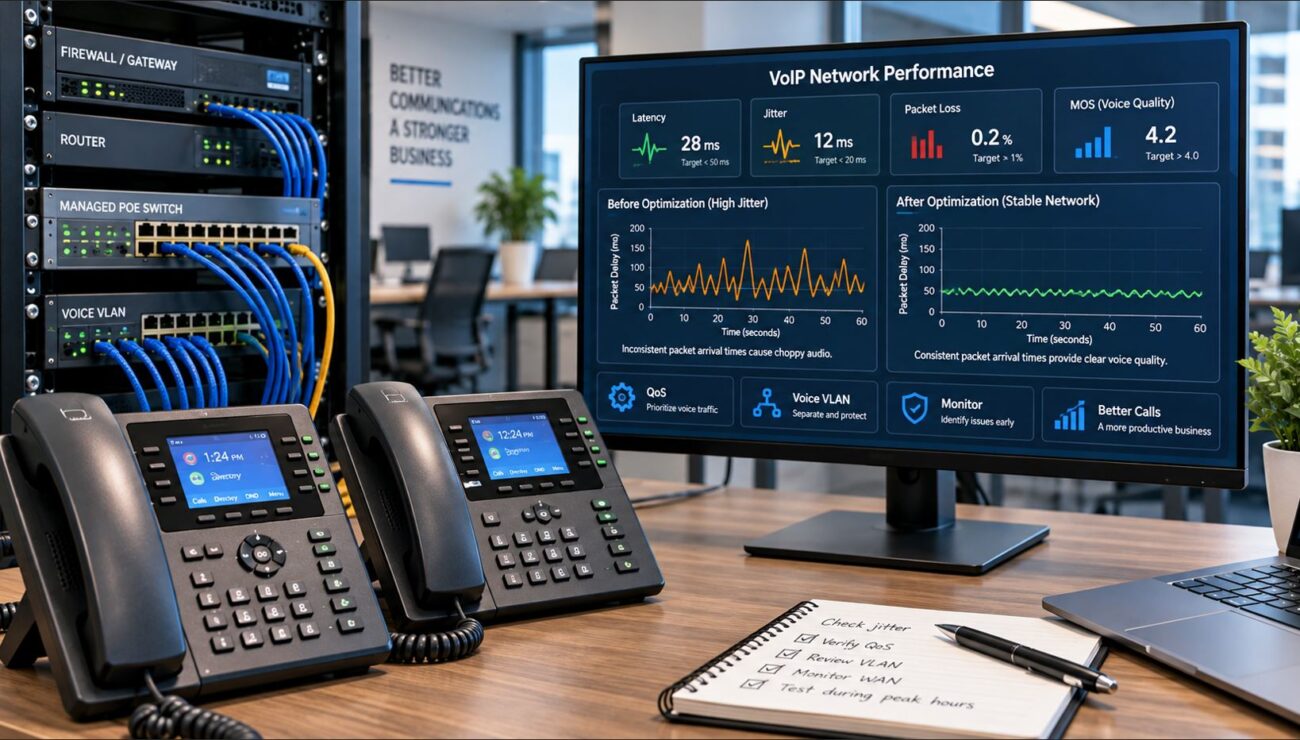
Also consider VLAN support, Quality of Service (QoS), uplink capacity, network monitoring, and the ability to prioritize voice traffic when choosing a managed switch.
7. Common PoE Problems and How to Avoid Them
Device Does Not Power On
Confirm that the Ethernet port actually supplies PoE, the device supports the switch’s power standard, and the switch has sufficient remaining power budget.
Device Reboots or Loses Features
Check for insufficient allocated power, an overloaded switch budget, cable problems, or a device requiring a higher PoE class.
Access Point Operates at Reduced Performance
Some access points disable features when supplied with less power than their recommended input. Review the manufacturer’s power requirements and the negotiated PoE class.
PoE Works on Short Cables but Not Long Ones
Inspect cable quality, conductor material, termination, and total cable length. Standard Ethernet channel lengths are generally limited to 100 meters, subject to the applicable installation requirements.
Use properly rated solid-copper cabling for permanent installations and avoid copper-clad aluminum cable, especially for higher-power PoE applications.
Switch Runs Out of Power
Review the switch’s PoE budget and per-port power allocation. Some managed switches allow administrators to configure power priorities so critical devices receive power first.
Frequently Asked Questions
Is PoE++ better than PoE+?
PoE++ provides more available power, but it is not automatically the better purchase. If every device operates within PoE+ limits, a suitable PoE+ switch may be more economical.
Can a PoE++ switch power a regular PoE phone?
Yes, a standards-compliant PoE++ switch can generally power compatible lower-power IEEE PoE phones through normal detection and classification.
Does PoE affect internet speed?
PoE itself does not determine Ethernet data speed. Network throughput depends on the Ethernet ports, cabling, connected equipment, and network configuration.
Do all wireless access points need PoE+?
No. Some access points use standard PoE, others require PoE+, and higher-power models may require PoE++. Check the manufacturer’s specifications.
Can PoE damage non-PoE devices?
Standards-compliant IEEE PoE switches normally detect compatible powered devices before applying power. Passive and proprietary PoE systems may behave differently and require additional caution.
How much PoE budget should a switch have?
Add the maximum power requirements of all connected devices, then allow appropriate capacity for future growth and operating conditions. Also verify the per-port power limits and number of PoE-capable ports.
Final Thoughts: Which PoE Standard Should You Choose?
For many basic business IP phones and low-power devices, standard PoE remains sufficient.
PoE+ is often a practical choice for mixed office networks with phones, wireless access points, and cameras.
PoE++ becomes important when higher-power equipment requires more electricity than PoE+ can provide.
The best decision comes from matching each device’s actual requirements to the switch’s supported standards, port capabilities, and total power budget.
Telecom-Store.com offers networking equipment for installations ranging from small offices to more demanding business environments. Explore the linked PoE switch and IP phone products in this guide to compare options for your deployment.
To provide the best experiences, we use technologies like cookies to store and/or access device information. Consenting to these technologies will allow us to process data such as browsing behavior or unique IDs on this site. Not consenting or withdrawing consent, may adversely affect certain features and functions.
Functional
Always active
The technical storage or access is strictly necessary for the legitimate purpose of enabling the use of a specific service explicitly requested by the subscriber or user, or for the sole purpose of carrying out the transmission of a communication over an electronic communications network.
Preferences
The technical storage or access is necessary for the legitimate purpose of storing preferences that are not requested by the subscriber or user.
Statistics
The technical storage or access that is used exclusively for statistical purposes.The technical storage or access that is used exclusively for anonymous statistical purposes. Without a subpoena, voluntary compliance on the part of your Internet Service Provider, or additional records from a third party, information stored or retrieved for this purpose alone cannot usually be used to identify you.
Marketing
The technical storage or access is required to create user profiles to send advertising, or to track the user on a website or across several websites for similar marketing purposes.