

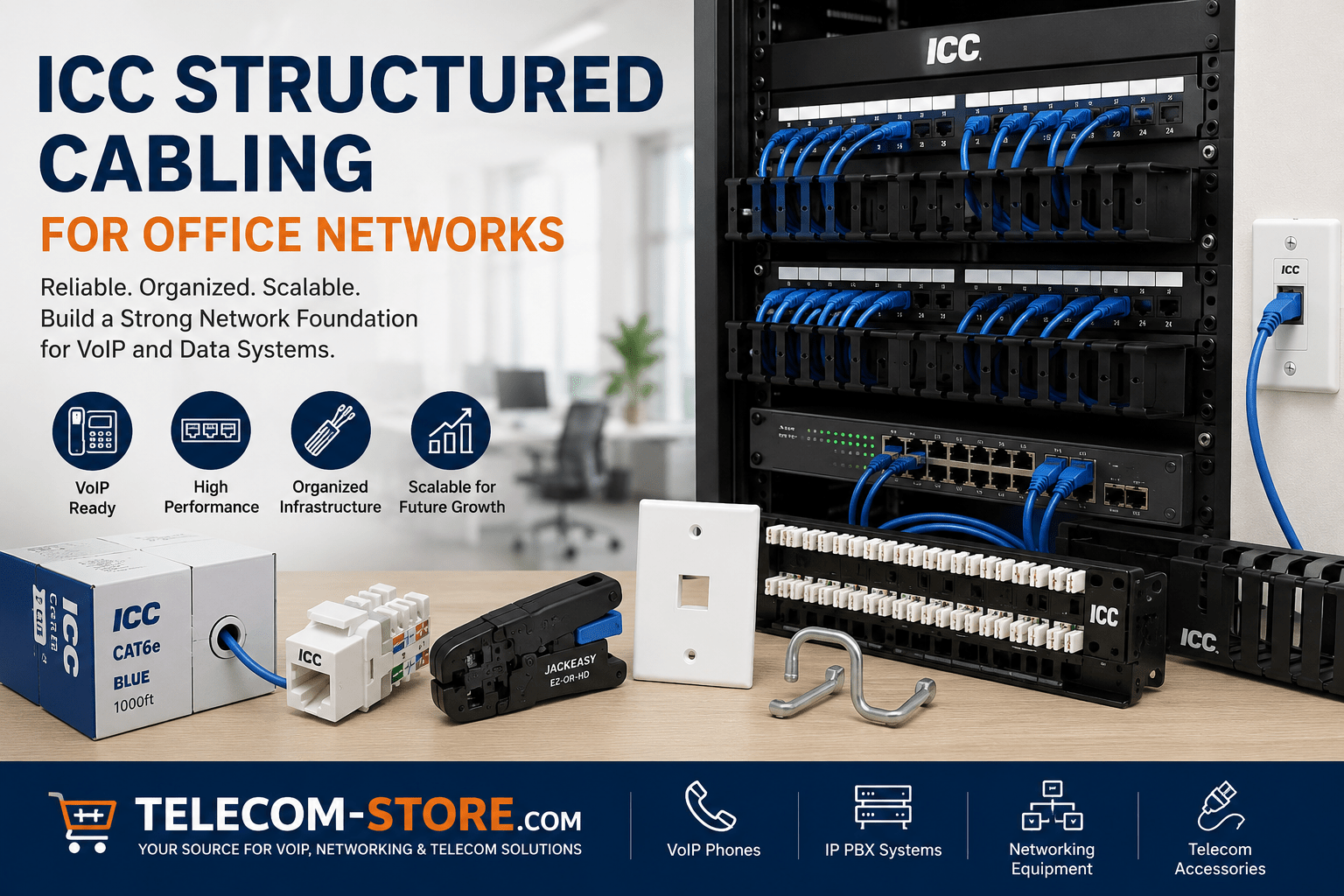
ICC Structured Cabling for Office Networks
Modern business communication depends heavily on reliable network infrastructure. Whether deploying VoIP phones, cloud communication systems, wireless access points, or structured office data networks, the physical cabling infrastructure plays a major role in long-term network performance.
ICC structured cabling for office networks is commonly used in commercial environments where organized cable management, scalable infrastructure, and low-voltage network reliability are important. Proper structured cabling design can help businesses support VoIP systems, workstation connectivity, patch panel organization, and future network expansion.
Businesses building or upgrading office network infrastructure often rely on CAT6 patch panels, ICC keystone jacks, ladder racks, and cable management accessories to create a clean and maintainable telecom environment.
Organizations looking for telecom hardware, VoIP phones, and structured cabling products can browse available equipment at:
Telecom-Store.com
Why Structured Cabling Matters in Office Networks
Structured cabling creates a standardized network infrastructure that supports voice, data, and communication systems throughout a building.
Instead of running unmanaged cables directly between devices, structured cabling systems organize network connectivity using:
- Patch panels
- Keystone jacks
- Cable pathways
- Ladder racks
- Horizontal cable management
- Telecom racks and cabinets
This organization simplifies troubleshooting, future upgrades, and network maintenance.
Businesses using VoIP systems, cloud communications, or IP-based devices often benefit from structured cabling because modern office technology increasingly relies on stable Ethernet connectivity.
ICC Structured Cabling for Commercial Installations
ICC low voltage products are commonly used in business environments because they support organized cable management and scalable office network infrastructure.
A typical ICC structured cabling deployment may include:
- CAT6 cabling equipment
- Patch panels
- Wall plates
- Keystone jacks
- Ladder rack systems
- Cable support hardware
- Telecom rack accessories
For example, CAT6 cabling installations often begin with quality bulk Ethernet cable such as:
Proper cable selection is important because cable quality affects:
- Signal integrity
- Installation flexibility
- Long-term durability
- Compliance with commercial building requirements
ICC Keystone Jacks and Termination Hardware
Keystone jacks are a core component of structured cabling systems. They provide termination points for Ethernet runs and help organize office network connectivity.
One example is the ICC CAT6 HD Keystone Jack for fast data networks:
ICC keystone jacks are commonly used in:
- Office workstations
- Telecom closets
- Conference rooms
- Patch panel systems
- Wall plate installations
Proper termination techniques are important for maintaining network performance and minimizing packet loss or signal degradation.
To simplify installation, technicians often use punch-down and termination tools such as:
Proper cable termination can help reduce wiring errors and improve consistency across larger office deployments.
Faceplates and Workstation Connectivity
Structured cabling systems extend beyond telecom rooms and network racks. Office workstations also require organized connectivity points.
Wall plates help create clean Ethernet termination locations for desks, conference rooms, and office work areas.
An example includes:
Faceplates help:
- Protect cable terminations
- Improve cable organization
- Maintain professional installation appearance
- Simplify future maintenance
Businesses deploying VoIP phones, workstations, and conference room devices often use standardized wall plate configurations throughout office spaces.
ICC Patch Panels and Cable Organization
Patch panels are central to structured office cabling systems because they consolidate cable runs into organized termination points.
A common solution for telecom installations includes:
CAT6 patch panels simplify:
- Network troubleshooting
- Cable identification
- Device relocation
- Future expansion
- Structured cable management
Businesses deploying multiple VoIP phones or workstation connections often rely on patch panels to keep network infrastructure organized inside telecom rooms.
For organizations using SIP-based phone systems and IP communication hardware, proper patch panel organization can simplify long-term administration.
VoIP systems and business communication hardware are available at:
Telecom-Store.com
Cable Support and J-Hooks
Horizontal cable support is important in commercial office environments. Improper cable support can place strain on Ethernet runs and increase the risk of long-term cable damage.
J-hooks are commonly used to support horizontal cable pathways above ceilings or through office spaces.
An example includes:
Cable support systems help:
- Reduce cable stress
- Maintain bend radius compliance
- Improve airflow
- Simplify future cable additions
- Organize cable pathways
Structured cable support becomes increasingly important as offices add:
- VoIP phones
- Wireless access points
- Security cameras
- Conference systems
- Network-connected devices
Horizontal Cable Management Panels
Cable management panels help organize patch cables and reduce clutter inside network racks.
An example of an ICC cable management accessory includes:
Horizontal finger duct panels help:
- Separate patch cords
- Improve rack organization
- Reduce cable tangling
- Simplify troubleshooting
- Improve airflow inside telecom racks
Proper cable management becomes increasingly important in larger office environments where multiple switches, patch panels, and VoIP systems share the same rack infrastructure.
Ladder Rack Systems for Telecom Rooms
Ladder rack systems are commonly installed in telecom closets and data rooms to support overhead cable routing.
An example includes the ICC 5-foot ladder rack:
Ladder rack systems help route:
- Fiber optic cabling
- CAT6 Ethernet cable
- VoIP network infrastructure
- Backbone cabling
- Inter-rack connections
For larger installations, corner sections are also commonly used:
These systems help create organized overhead pathways while reducing cable congestion in telecom rooms.
Structured Cabling and VoIP Systems
Modern VoIP deployments rely heavily on structured cabling quality.
VoIP phones require:
- Stable Ethernet connectivity
- Proper switch configuration
- Consistent cable performance
- Organized patch panel routing
Poor cabling practices can contribute to:
- Packet loss
- Call quality problems
- Intermittent connectivity
- Power over Ethernet issues
Organizations deploying VoIP systems frequently pair structured cabling infrastructure with SIP phones and hosted PBX systems from providers such as: Axion Communications
Many businesses using Yealink phones and IP communication systems benefit from organized structured cabling because it simplifies troubleshooting and future expansion.
Buyer Considerations Before Deployment
Before installing ICC structured cabling for office networks, businesses should evaluate several planning considerations.
Network Growth Expectations
Organizations planning future expansion should install additional cable capacity whenever possible.
Adding extra cable runs during initial construction is often less expensive than retrofitting later.
Cable Category Selection
CAT6 cabling remains common for office environments because it supports:
- Gigabit Ethernet
- VoIP systems
- Wireless access points
- Video conferencing
- Power over Ethernet devices
Rack Space Planning
Telecom rooms should include:
- Adequate rack space
- Cable management pathways
- Power distribution
- Cooling considerations
- Future expansion capacity
Compliance and Building Requirements
Commercial installations may require compliance with:
- Local building codes
- Fire rating requirements
- Plenum or riser cable standards
- Low-voltage regulations
Businesses should verify requirements before installation.
Common Limitations and Challenges
Structured cabling installations can involve several practical challenges.
Installation Labor
Large office cabling projects may require significant installation time depending on:
- Building layout
- Ceiling access
- Existing infrastructure
- Cable routing complexity
Cable Management Discipline
Without proper labeling and organization, even high-quality cabling systems can become difficult to maintain over time.
Future Technology Changes
Although CAT6 remains widely used, organizations planning long-term infrastructure may eventually require higher bandwidth standards depending on future application demands.
Conclusion
ICC structured cabling for office networks provides a foundation for modern business communication systems, VoIP deployments, and organized Ethernet infrastructure.
Patch panels, keystone jacks, cable management systems, ladder racks, and CAT6 cabling equipment all contribute to maintaining reliable office connectivity and scalable network organization.
Businesses planning office network upgrades should consider:
- Long-term growth requirements
- Rack organization
- Cable routing
- VoIP compatibility
- Cable management practices
- Commercial installation standards
Careful planning during the cabling phase can simplify maintenance and support future business technology expansion.
FAQ Section
What is ICC structured cabling used for in office networks?
ICC structured cabling is used to organize Ethernet, VoIP, and low-voltage network infrastructure in office environments. It helps businesses manage cable routing, patch panel organization, workstation connectivity, and telecom room layouts while supporting scalable network expansion.
Are ICC patch panels compatible with CAT6 office networks?
Yes. Many ICC patch panels are designed specifically for CAT6 Ethernet infrastructure and can support Gigabit network environments commonly used in office networks, VoIP systems, and business communication deployments.
Why are ICC keystone jacks important for structured cabling?
ICC keystone jacks provide standardized Ethernet termination points for workstations, patch panels, and wall plates. Proper keystone termination helps maintain network performance and simplifies troubleshooting in structured office cabling systems.
What are ladder racks used for in telecom rooms?
Ladder racks support overhead cable routing inside telecom closets and data rooms. They help organize Ethernet backbone cabling, fiber optic runs, and inter-rack cable pathways while reducing cable congestion.
Is CAT6 still recommended for office network infrastructure?
Yes. CAT6 cabling remains widely used in office network infrastructure because it supports Gigabit Ethernet, VoIP phones, Power over Ethernet devices, and wireless access points while offering good long-term compatibility for most business environments.
What are the benefits of structured cabling for VoIP systems?
Structured cabling can improve VoIP system reliability by providing organized Ethernet routing, consistent patch panel management, and simplified troubleshooting. Proper cabling infrastructure may also help reduce packet loss and network-related call quality issues.
How do cable management panels help network racks?
Cable management panels help organize patch cords inside telecom racks. They improve airflow, reduce cable tangling, simplify maintenance, and create cleaner rack layouts for network switches and patch panels.
What should businesses consider before installing office structured cabling?
Businesses should evaluate future network growth, cable category requirements, rack space planning, cable routing pathways, building code compliance, and VoIP compatibility before beginning a structured cabling installation.