

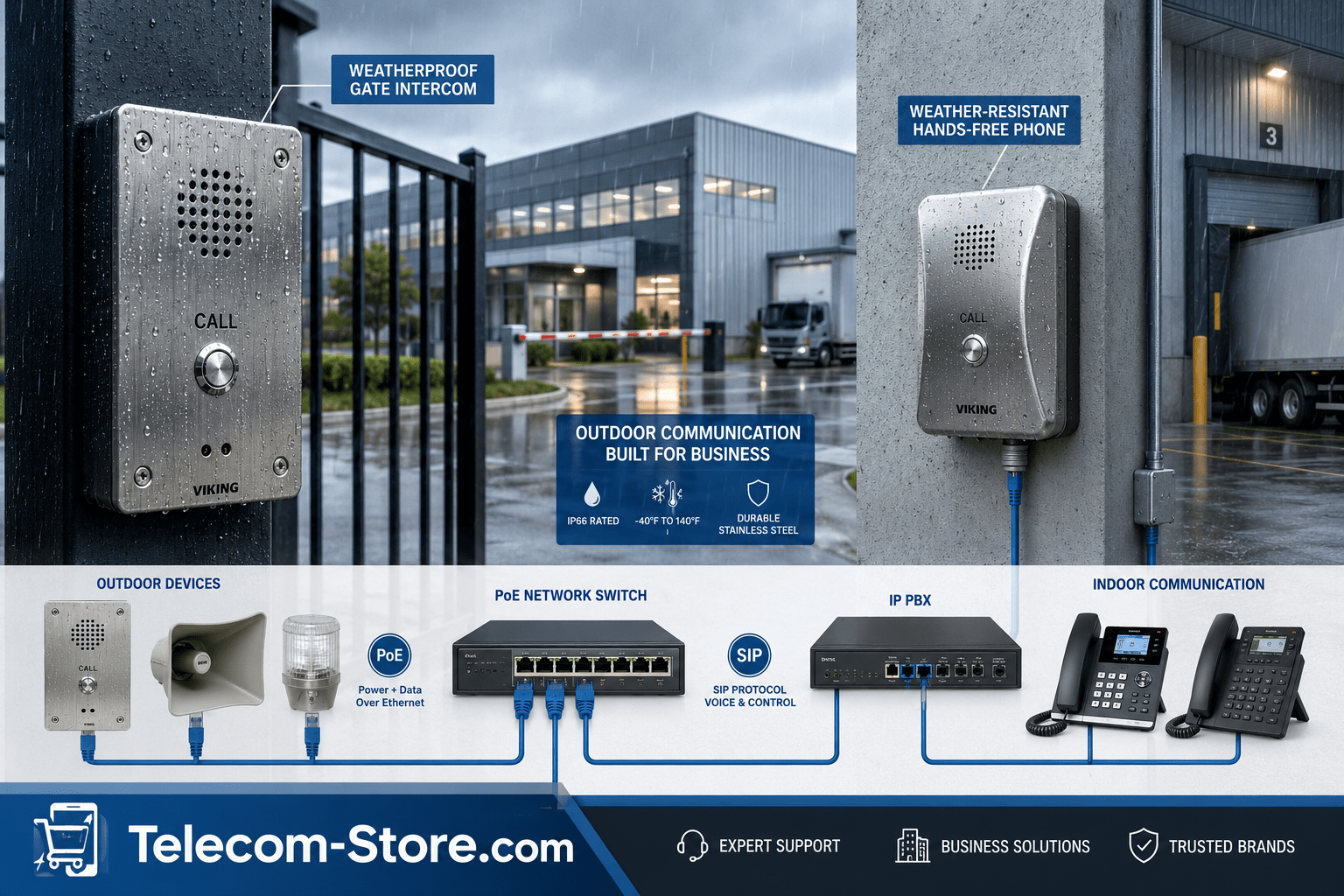
Weatherproof intercoms help businesses maintain reliable voice communication at gates, entrances, loading docks, warehouses, parking areas, campuses, and other locations exposed to outdoor conditions. Unlike a standard indoor desk phone or intercom station, an outdoor communication device is designed with an enclosure and installation method suited to moisture, dust, temperature changes, and physical exposure. For buyers in 2026, the right choice increasingly depends on more than weather resistance alone. Network compatibility, SIP support, Power over Ethernet, audio performance, mounting location, and integration with an existing phone system all matter.
The direct answer is simple: a business should choose a weatherproof intercom based on the installation environment, required ingress protection, communication method, network infrastructure, calling workflow, and integration requirements. A gate may need a rugged hands-free call station, while a warehouse yard may need a weatherproof horn speaker for paging. A SIP-based outdoor device may connect to an IP PBX or cloud communications platform, whereas another application may require an analog interface or 70V paging equipment. The correct product is the one that matches both the physical environment and the communication system.
What Weatherproof Intercoms Mean for Business Communication
A weatherproof intercom is a communication device designed for locations where an ordinary indoor phone or call station may be exposed to rain, dust, humidity, airborne debris, or changing temperatures. Depending on the product, it may provide two-way hands-free calling, one-way or two-way paging, door or gate communication, emergency calling, or integration with a SIP-based business phone system.
The term weatherproof should not be treated as a universal promise that every device can survive every outdoor condition. Buyers should review the manufacturer’s environmental specifications, supported temperature range, mounting instructions, and ingress protection rating. An IP66-rated enclosure, for example, addresses specific levels of protection against dust and water exposure, but installation details still matter.
Businesses comparing outdoor communication options can examine purpose-built devices such as the Viking Electronics 3EWP weatherproof hands-free stainless-steel phone. A product of this type is more relevant to exposed communication points than placing a conventional indoor desk phone in a basic outdoor location.
Weatherproof Intercoms: Main Types and Differences
Outdoor business communication is not a single product category. The main options include weather-resistant hands-free phones, SIP intercoms, IP speakers, paging horns, door stations, gate call stations, and analog or 70V loudspeakers. Buyers should first determine whether the application requires a private conversation, a call to a receptionist, a broadcast announcement, or integration with access control.
What Is a Weatherproof Hands-Free Intercom?
A weatherproof hands-free intercom allows a visitor, employee, driver, or contractor to initiate or receive communication without using a conventional handset. These devices are commonly considered for gates, service entrances, industrial areas, and exposed building locations. Stainless-steel construction may be useful where durability and cleaning are important, although enclosure material alone does not determine the full environmental rating.
What Is an Outdoor SIP Intercom?
An outdoor SIP intercom uses Session Initiation Protocol to communicate with compatible IP PBX systems, SIP servers, or supported hosted voice platforms. In a properly designed system, the intercom can function as a network endpoint with an extension or calling rule. This can make it possible for a gate station to call a receptionist, security desk, ring group, or another authorized destination.
What Is an Outdoor IP Paging Device?
An outdoor IP paging device is designed primarily for announcements rather than private conversations. For example, the CyberData CD-011457 IP66 weatherproof horn speaker is relevant when the goal is network-based outdoor paging. This type of product may suit yards, loading areas, industrial facilities, and other spaces where announcements must reach people away from desk phones.
Why Weatherproof Intercoms Matter in 2026
Business communication systems increasingly combine cloud calling, SIP endpoints, IP PBX platforms, mobile users, video meetings, access control, and network-based paging. As a result, an outdoor communication point is often expected to participate in the same broader communications environment as indoor phones and applications.
This matters because buyers may want an outdoor caller to reach employees who are not physically sitting at a reception desk. Depending on platform compatibility and configuration, calls may need to route to a desk phone, ring group, security station, or other endpoint. However, buyers should verify support before assuming that any SIP intercom works with every cloud phone service.
Hybrid Work and Cloud Communication
Hybrid work has changed reception and facility communication. A visitor at a gate may need to reach an employee who works from multiple locations. An outdoor SIP intercom can be useful when it integrates correctly with the organization’s call-routing system, but the exact workflow depends on the IP PBX or hosted platform.
Businesses evaluating broader endpoint options can compare VoIP phones for indoor users and IP PBX products for compatible on-premises communication environments. Brands such as Yealink, Poly, Cisco, and Grandstream may appear elsewhere in a business communications deployment, but brand presence does not automatically establish compatibility with a particular outdoor intercom.
Buyer Expectations in 2026
Modern buyers commonly expect clear compatibility information, straightforward deployment, secure administration, reliable power, remote management where supported, and room for expansion. For network-connected intercoms, buyers may also expect PoE support, VLAN compatibility, QoS planning, firmware maintenance, and integration with existing switching infrastructure.
Key Features and Factors to Consider
The most useful buying process starts with the environment and communication workflow. A device should not be selected only because it is labeled for outdoor use. The network, power source, call destination, mounting position, audio environment, and future maintenance requirements should also be reviewed.
Weather and Ingress Protection
Check the stated IP rating and manufacturer installation requirements. IP ratings describe specific protection levels against solids and water. Buyers should not assume that terms such as weather-resistant, weatherproof, and waterproof are interchangeable. Direct rain, wind-driven moisture, washdown exposure, dust, and sheltered outdoor mounting can create different requirements.
SIP and VoIP Compatibility
If the device will connect to an IP phone system, determine whether it supports SIP and whether the intended IP PBX or cloud service permits third-party endpoints. Confirm authentication requirements, codecs, DTMF methods, extension provisioning, and call routing. Some platforms are more open to generic SIP devices than others.
PoE Support
Power over Ethernet can simplify deployment by carrying compatible network connectivity and electrical power over Ethernet cabling. However, the switch and endpoint must support compatible PoE standards, and the total PoE power budget must be sufficient. Buyers can explore PoE switch options when planning network-powered communication devices.
VLAN Support
A VLAN can logically separate voice, intercom, camera, or other network traffic according to the organization’s design. VLAN capability is generally associated with managed network infrastructure. The correct configuration depends on the switch, router, security policies, and communications platform.
QoS for Voice Traffic
Quality of Service can help prioritize delay-sensitive voice traffic when the network is congested. QoS is not a substitute for adequate bandwidth or proper network design, but it can be valuable in networks carrying voice, video, data, and other traffic simultaneously.
Audio Output and Noise
Outdoor environments can be difficult for voice communication. Traffic, machinery, wind, forklifts, and large open spaces may reduce intelligibility. A quiet gate entrance and a noisy industrial yard may require very different devices. Buyers should consider speaker output, microphone design, expected listening distance, and whether the application needs private conversation or broad paging coverage.
Mounting and Cabling
Review wall, pedestal, flush, or surface-mount requirements before ordering. Outdoor Ethernet runs may need appropriate cable, conduit, grounding practices, surge protection, and compliance with local electrical and building requirements. A weather-rated endpoint cannot correct an improperly protected cable entry or unsuitable network installation.
Security
Network-connected intercoms should be treated as managed endpoints. Change default credentials where applicable, maintain supported firmware, restrict unnecessary network access, and follow vendor guidance. Businesses using managed switches from brands such as TP-Link, Intellinet, Cisco, or other networking vendors may also use segmentation and access controls where the equipment supports them.
Remote Management
Remote administration can reduce service effort across multiple buildings or locations, but capabilities vary. Buyers should determine whether configuration requires a local web interface, centralized management platform, provisioning server, or direct access to each device.
Budget and Scalability
Initial hardware price is only part of the cost. Consider switching, PoE capacity, cabling, licenses, mounting hardware, surge protection, installation labor, and ongoing administration. A small single-gate system may have different economics than a multi-building campus with dozens of outdoor endpoints.
Recommended Product Types to Explore
The appropriate product category depends on what people need to do at the outdoor location. A buyer should distinguish two-way calling from one-way paging before comparing products.
For Gates and Outdoor Entrances
A weather-resistant hands-free phone or intercom may be appropriate when visitors need to call an employee, receptionist, or security point. The Viking Electronics 3EWP weatherproof hands-free phone is one product type to examine for exposed communication applications. Buyers should verify the required interface and system compatibility before ordering.
For Warehouses and Industrial Yards
Outdoor paging may be more useful than a private intercom where announcements must reach a broad area. The Bogen KFLDS30T weatherproof 30W horn speaker is relevant to outdoor loudspeaker applications. For 70V systems with different power requirements, buyers can also review the Bogen HS7EZ weatherproof horn speaker.
For Network-Based Outdoor Paging
Businesses moving toward IP-based communications may prefer a network-connected paging endpoint. A device such as the CyberData IP66 weatherproof horn speaker can fit a different architecture from a traditional analog or 70V horn. The choice should follow the existing paging platform, network design, SIP requirements, and desired management method.
For Visual Notification
Some environments require more than audible communication. The Algo SIP IP visual notification and LED strobe product may be relevant where compatible network-based visual alerting is part of the communication plan. Buyers should verify triggering, SIP integration, power, and environmental placement requirements rather than assuming an indoor visual device is automatically suitable for exposed outdoor mounting.
Compatibility and Setup Requirements
Compatibility is one of the most important parts of selecting weatherproof intercoms. A device can be physically suitable for an outdoor location and still be wrong for the existing phone or network system.
Check the Communication Platform First
Identify whether the business uses an on-premises IP PBX, hosted cloud phone service, analog phone interface, 70V paging system, or another architecture. SIP support is valuable, but generic SIP registration may not be available on every hosted service. Confirm platform support before purchase.
Review the Network Switch
Network-connected intercoms need appropriate Ethernet connectivity. Buyers can compare network switches based on port count, speed, management requirements, and power needs. A simple network may use an unmanaged switch, while voice VLANs, QoS policies, monitoring, or remote administration may justify a managed switch.
Confirm the PoE Power Budget
A switch having PoE ports does not mean it can power an unlimited number of endpoints. Add the expected power requirements of connected phones, access points, cameras, intercoms, and other PoE devices. Then compare the total with the switch’s available PoE budget and per-port capabilities.
Plan VLANs and QoS Where Needed
Some business VoIP deployments use dedicated voice VLANs and QoS policies. An outdoor SIP endpoint may need to follow the same network plan. Configuration requirements vary, so businesses without internal IT support may benefit from qualified network assistance.
Maintain Firmware and Credentials
Firmware updates can address compatibility, stability, and security issues. Before deployment, review the manufacturer’s supported firmware process and change default administrative credentials where applicable. Document endpoint addresses, extensions, configuration settings, and ownership responsibilities.
Common Limitations Buyers Should Know
Weatherproof intercoms have practical limitations. First, an outdoor enclosure does not make a device suitable for every climate or installation. Buyers must review environmental ratings and mounting requirements. Second, SIP support does not guarantee compatibility with every IP PBX or cloud provider.
Third, not all network intercoms support PoE, and not all PoE switches provide the same standards or power budget. Fourth, outdoor Ethernet cabling can require additional protection and careful installation. Fifth, audio quality can be affected by wind, machinery, road noise, and mounting position.
Traditional paging horns also have different requirements from SIP endpoints. For example, a 30-watt reentrant horn loudspeaker belongs to a different system design than an IP network speaker. Buyers should not select products solely by appearance or wattage.
How to Choose the Right Option
A practical buying decision begins with the communication task. Define who initiates communication, who receives it, whether the conversation is private, how the device is powered, and what system must control the call.
Choose by Business Size
A small office with one exterior service entrance may need a single call point and straightforward routing. A growing business may need multiple entrances, warehouse paging, PoE switching, and integration with an IP PBX. A campus may require centralized management, VLAN planning, redundant network design, and coordinated paging zones.
Choose by Environment
Determine whether the location is sheltered, directly exposed to rain, dusty, subject to washdown, vulnerable to impact, or located near heavy machinery. Review temperature and ingress specifications. If vandal resistance is important, examine enclosure construction and mounting design separately from weather resistance.
Choose by Call Workflow
Ask where an outdoor call should go. Options may include a receptionist, security desk, extension, ring group, or another destination supported by the phone system. If employees use Yealink phones, Poly phones, or Cisco phones, verify the overall PBX or cloud platform workflow rather than assuming endpoint brands determine intercom compatibility.
Choose by IT Support Level
A simple standalone installation may be easier for a small organization to maintain. Managed SIP endpoints, VLANs, QoS, firewall policies, and remote provisioning require more technical knowledge. Businesses should select a design that matches available IT resources as well as desired features.
Choose for Future Expansion
Consider whether the business may add doors, buildings, outdoor paging zones, cameras, wireless access points, or additional phones. A switch with no spare ports or PoE capacity may create an avoidable replacement project later. Future growth should be considered without buying unnecessary complexity.
Related Telecom Products
Outdoor intercom projects often depend on supporting infrastructure. Businesses building an IP-based system can explore managed network switches when VLANs, QoS, monitoring, or administrative control are needed. Smaller deployments can compare unmanaged switches when straightforward Ethernet connectivity is the main requirement.
For broader network planning, networking equipment may include switches and related infrastructure. Buyers should match port speeds, uplink requirements, PoE standards, power budget, and management features to the actual deployment.
Communication projects may also involve conference phones, video conferencing products, or meeting room devices. These products serve different communication needs, but they may share the same business network and therefore affect bandwidth, switching, VLAN, and PoE planning.
Conclusion
Weatherproof intercoms can provide practical outdoor business communication at gates, entrances, warehouses, loading docks, campuses, and industrial locations. The right choice depends on environmental exposure, required communication workflow, SIP or analog architecture, PoE availability, network design, audio conditions, and compatibility with the existing phone system.
For buyers, the most reliable approach is to define the use case first and compare products second. Verify environmental ratings, platform support, power requirements, cabling, call routing, and management needs before ordering. That process helps businesses choose weatherproof intercoms and related outdoor communication equipment based on real operating requirements rather than a single feature or product label.
FAQ Section
What is the best type of weatherproof intercom for a business gate?
The right type depends on how the gate is used. If visitors need two-way communication with reception or security, consider a weather-resistant hands-free intercom or SIP call station. If the business already uses an IP PBX, a compatible outdoor SIP intercom may simplify call routing. Check the environmental rating, mounting method, power source, audio conditions, and phone-system compatibility before choosing a device.
Can a weatherproof SIP intercom work with a VoIP phone system?
Yes, many weatherproof SIP intercoms can work with compatible VoIP systems, but SIP support alone does not guarantee compatibility. Confirm whether the IP PBX or hosted provider allows the specific endpoint or generic SIP registration. Also check authentication, codecs, DTMF support, extension configuration, call routing, and network requirements. Hosted platforms may impose different restrictions than an on-premises IP PBX.
Do outdoor intercoms need a PoE switch?
Only if the intercom supports or requires Power over Ethernet. A PoE-capable outdoor intercom may receive compatible power and network connectivity through Ethernet cabling, which can simplify installation. However, the network switch must support the required PoE standard and have enough available power budget. Some outdoor intercoms use separate power supplies, while analog and 70V paging devices follow different electrical designs.
Should I use a managed or unmanaged switch for an outdoor IP intercom?
An unmanaged switch may be sufficient for a small, straightforward installation that only needs basic Ethernet connectivity. A managed switch is generally more appropriate when the network requires voice VLANs, QoS, monitoring, port controls, remote administration, or more detailed troubleshooting. The decision should reflect the entire network design, not only the intercom. Multi-site and growing businesses often benefit from greater management capability.
What IP rating should an outdoor business intercom have?
The required IP rating depends on actual exposure. A device under a protected canopy may face different conditions from one exposed to wind-driven rain, dust, or industrial debris. Review the manufacturer’s IP rating, temperature range, and installation instructions. An IP66-rated product provides defined protection against dust and water exposure, but buyers should still use suitable mounting, cable entry, and installation practices.
Can an outdoor intercom call Yealink, Poly, or Cisco phones?
Potentially, but the phone brand alone does not determine compatibility. The key factor is the communications platform connecting the devices. A SIP intercom may register to a compatible IP PBX and call extensions assigned to Yealink, Poly, Cisco, or other phones. Cloud platforms can have different endpoint restrictions. Verify the PBX, SIP service, licensing, codec support, and call-routing rules before purchasing equipment.
What is the difference between an outdoor intercom and a weatherproof horn speaker?
An outdoor intercom is generally intended for interactive communication, often allowing a person to initiate or participate in a call. A weatherproof horn speaker is primarily intended to broadcast announcements over a wider area. Some IP paging systems support advanced features, but a horn speaker should not automatically be treated as a private two-way call station. Choose based on whether the application needs conversation, paging, or both.
How much PoE power do I need for outdoor intercoms and VoIP devices?
Add the maximum or planned power requirements of all connected PoE endpoints, including intercoms, VoIP phones, wireless access points, cameras, and other devices. Then compare that total with the switch’s available PoE budget and per-port capabilities. Leave practical room for expansion where appropriate. Do not assume that a switch with many PoE-labeled ports can simultaneously deliver maximum power to every connected device.
What should I check before buying a weatherproof intercom system?
Check the environmental rating, temperature range, mounting location, communication workflow, SIP or analog interface, IP PBX compatibility, PoE requirements, network switch capacity, cabling, audio conditions, and future expansion plans. Also determine who will configure and maintain the system. A technically advanced intercom may be a poor fit if the business lacks the network infrastructure or administrative resources required to support it properly.